Reaching Back

September 19, 2019

Written by Ross Morgan, September 2019.

In the first few years of the Forest Stewards Guild, members used quotes from Josef Kostler’s book, Silviculture , to stimulate thought and ideas for the forming organization.  The discussions that led to articulating our principles and mission have some roots in these quotes. Kostler was a Bavarian forester, as was his father, and he was a silviculture professor at the University of Munich. References that the author uses for this book date from the late 1800’s.  By reaching back into the history of the forestry movement in Central Europe, we were hoping to gain insight into our long-term professional assignment–into who we are and how we could direct our own future.

Central to my understanding of this assignment, then and now, is found where Kostler quotes Forester Ammon about a hundred years ago.

 The marking of the trees to be exploited is undoubtedly the most important task of all, the true central function of the professional forester. …..Someone who has the making of a forester…. finds in the task of marking great professional satisfaction, more especially when permitted to follow out the development of forests and their constant improvement over a matter of decades. 

Here Kostler reveals the keystone in the forestry movement, the foot soldier in the process, the field forester who decides what is to be retained in the stand, and what is to be harvested for use.  Policy, research, understanding of economics and of the complexity of forest ecology can all be in place, but if there is not a forester in the woods, who decides and marks the trees in a silvicultural regime with consideration for ecological functions, the forestry work is set back, often for many decades.  The forester’s decisions bring a carefully planned silviculture to fruition for society.  Yes, any silviculture is an intrusion into the forest, but it is calibrated as carefully as humans can; that is our assignment.

After the first meeting in Santa Fe in 1995, a bulletin was produced which contained many quotes inspired by our first introduction circles and discussions by those thirty participants; here are a few:

Robert Hrubes said, “I want to see an organization created out of this.  I want to be part of an organization that reflects my values.”

Charlie Moreno is quoted, “I regard the conference as a ‘watershed’ event in my career.  Beyond the intellectual exchange, it was an affirmation of the deeply held beliefs about working with the forest.”

Fred White wrote “We need to recognize that this is a fringe group.  At the same time, we should not underestimate the power of such a group to leverage change.”

Jim Greig stated, “If you start with a virgin old growth stand, there is nothing you can do to enhance ecosystem function.”  He also said, “The practice of silviculture becomes an art.”

By offering these quotes, from Kostler, who taught generations of European foresters, to Jim Greig, who influenced many younger California foresters, I am encouraging you to reach back twenty-five or more than a hundred years, to see who we were and consider who we can become.

Recent Posts

By Daisy Smith May 14, 2026
Written by Zander Evans
By Daisy Smith May 14, 2026
Written by Zander Evans
May 14, 2026
A science inspired art show in Taos, NM Written by Cody Dems
By Aidan Juhl April 16, 2026
Written by Colleen Robinson
April 14, 2026
Written by Shannon Maes
April 14, 2026
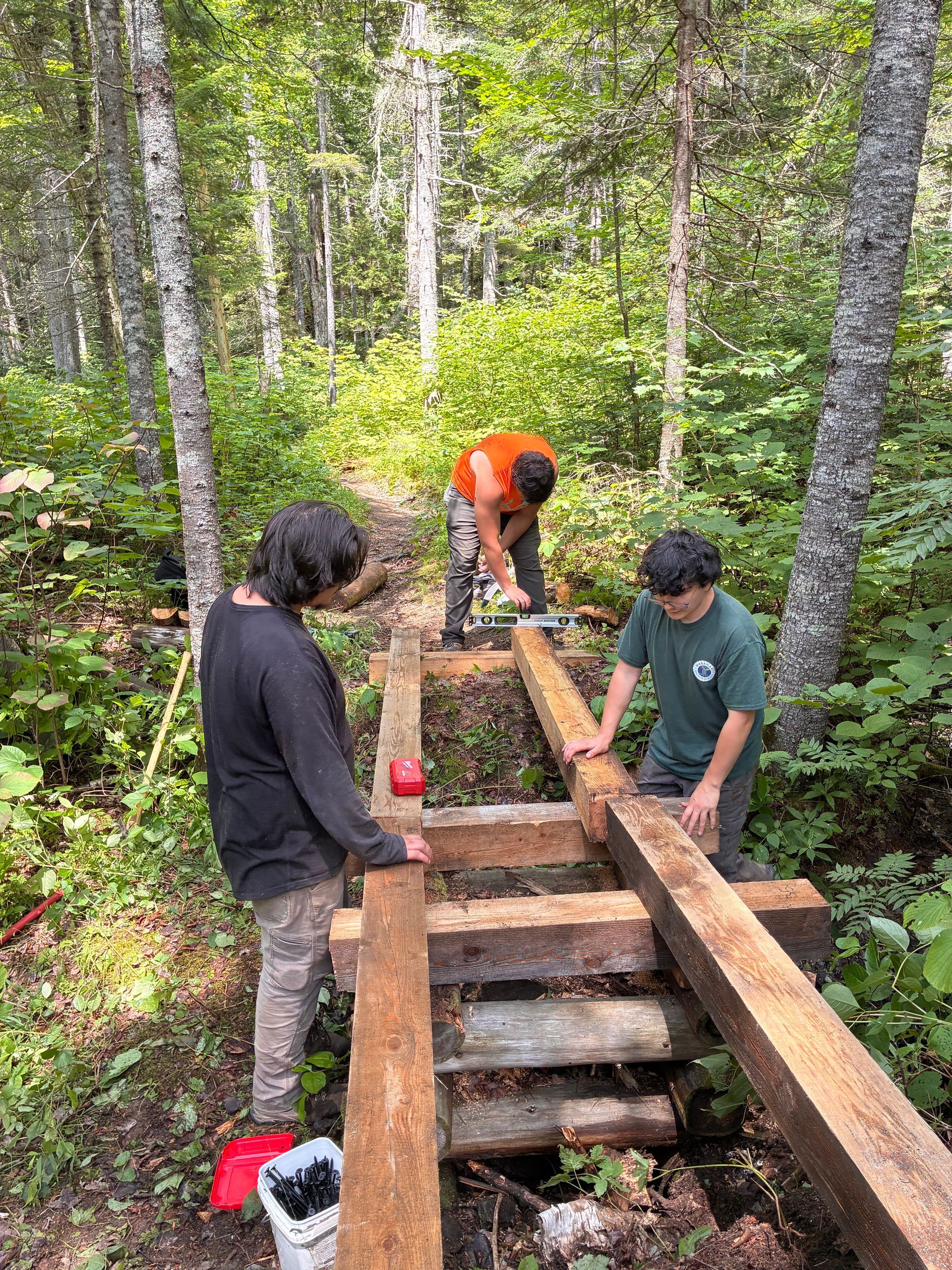
In September 2025, the Guild launched a three-person Forest Stewards Apprenticeship (FSA) crew to work with the Penobscot Nation’s Department of Natural Resources (PN DNR). Over the course of their six-month season, apprentices Agenor Duhon, Gabe Stewart, and Jacob Baker shared a season of learning, collaboration, and hands-on stewardship of Penobscot Tribal lands.
April 14, 2026
This week, I stepped into the role of crew leader. We worked a full 40-hour week, splitting our time between Clifton Farms and a prescribed burn operation. On the first day in the field, we completed hack-and-squirt treatments on trees that had been marked the previous week. For the remainder of the week, we focused on marking trees for future hack-and-squirt work, maintaining a steady pace and ensuring accuracy in our selections.
April 7, 2026
As Guild members, our practice is fundamentally grounded in field observation. We know intuitively that forests are dynamic, living communities. Yet, for decades, the high-level systems used to value our work, specifically the carbon accounting ledgers tied to international frameworks like the Paris Agreement, have treated forests as static, quantifiable blocks of land. In a recent commentary published in One Earth, I argue that these legacy measurement, reporting, and verification (MRV) frameworks are failing. Ledger accounting relies on crude land-use delineations and outdated technology, effectively penalizing the natural, seasonal flux of the ecosystems we manage every day. By forcing landscapes into rigid “forest” versus “non-forest” binaries, such legacy systems miss the complex reality on the ground. But a major shift is underway.
March 18, 2026
Women have always been a part of forestry. Historically, women often helped guide family decisions about when to cut, which trees to save, and how best to steward their land for the next generation. Historical accounts from the Southern Appalachians describe women’s roles in decisions about timber harvesting and prioritizing long-term forest health. These often-uncredited contributions are even reflected in Aldo Leopold’s A Sand County Almanac (1949), in which describes his stewardship philosophy informed not only by his professional experience, but by shared responsibility, where the perspectives of his wife and daughters played an important role.
March 18, 2026
Although rural regions often host the highest concentrations of public and private forest land, they typically lack the sustainable workforce necessary for active management and stewardship. How do we address this foundational problem in forest conservation?
Show More