
Where These Waters Flow
Written by Roman Colangelo
The heart of Alabama is cleaved by 194 miles of freshwater. On a five-mile segment of the Cahaba River, just outside Birmingham, were several canoes headed by Wil Rainer and backed by La’Tanya Scott of the Cahaba River Society. A joint venture between the University of Alabama and Mississippi State University chapters of the Guild had resulted in a unit of clumsy and joyful students desperately knifing at the water with their paddles. Just below the surface was a rockface adorned with the fossilized remains of Earth’s first photosynthetic organisms, primordial biomass forever entwined with the hallowed grounds that it once ruled.
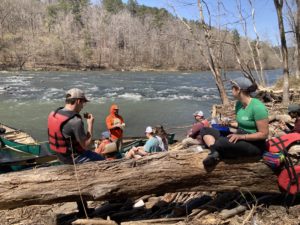 The edges of the river were crowned with privet, foliage faded from the ritualistic surging and receding of the Cahaba. Cane desperately held onto what land it could claim along the river. We stumbled upon a sycamore that had managed to affix itself to the earth while at a strong tilt. Further down the river stood another sycamore with a split trunk that had conquered its own little island, a tuning fork that harmonized with the song of the Cahaba. While docked on a little rocky bank, our party was witness to a singular turtle that had bested the flow of the river and stood victorious on one of the few rocks protruding out of the water. It seems that the turtle was a portent of mischief, as that same rock proved to be a troublesome obstacle in our efforts to defeat the rapids. My canoe partner and I had conquered the first rapid, but our shared moment of relief proved to be our downfall, as we had failed to generate enough momentum to best the following rapid. We decided that we were both content to remain prisoners of the rock while the rest of the group caught up.
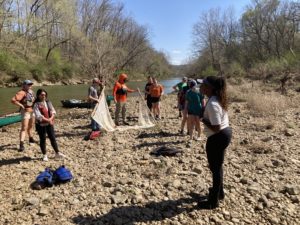
Near the end of our journey, we saw the roots of a sycamore that stood on eroded ground, bared naked and grasping for any source of stability. The decline of stabilizing riparian vegetation along the Cahaba has caused the river to become increasingly sedimented. The hundreds of species cradled in the Cahaba enter an uncertain future in the face of an increasingly unfamiliar home. Early European records of the Cahaba tell a story of a pristine river, a portrait that reflects not only our shortcomings in stewarding the river but also its lost beauty.
The heartbeat of the Cahaba carries the legacy of its rich biodiversity. It is waking history, a winding, mystic path that hums with life and weaves a beautiful web of ecology. The day I spent on the river with my peers from the Forest Stewards Guild is one of my fondest memories and a reminder of why we must responsibly steward our lands and waters.