
How Digital Intelligence is Catching Up to Field Stewardship
Written by Chris Woodall of CTrees
As Guild members, our practice is fundamentally grounded in field observation. We know intuitively that forests are dynamic, living communities. Yet, for decades, the high-level systems used to value our work, specifically the carbon accounting ledgers tied to international frameworks like the Paris Agreement, have treated forests as static, quantifiable blocks of land. In a recent commentary published in One Earth, I argue that these legacy measurement, reporting, and verification (MRV) frameworks are failing. Ledger accounting relies on crude land-use delineations and outdated technology, effectively penalizing the natural, seasonal flux of the ecosystems we manage every day. By forcing landscapes into rigid “forest” versus “non-forest” binaries, such legacy systems miss the complex reality on the ground. But a major shift is underway.

Machine learning techniques enable rapid and scalable detection of individual trees. In the Lake Tahoe area in California, an AI-enabled map reveals trees (white crowns) otherwise excluded from high-uncertainty land use categories in the National Land Cover Dataset: forest (green), suburbann/urban (grey and red), and woodland (transparent). Lake Tahoe Region, CA
Technology has finally matured enough to see the landscape as a forester does: tree by tree. In basic terms, “digital intelligence” just means giving our computers the ability to instantly translate massive piles of raw data, like a satellite picture or a drone scan, into a working, real-time map of the forests, helping us make decisions on the ground. In the past, remotely sensed observations could crudely define somebody’s concept of a “forest” separate from a “woodland” all the while ignoring field-level observations and local knowledge. The future is dynamic identification of individual trees deeply connected to field observations and communities. This is the promise of tree-centric digital MRV (dMRV).
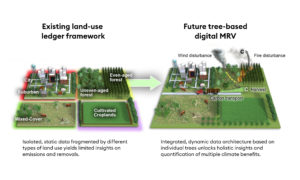 At its core, dMRV is the application of digital intelligence to natural ecosystems. It harnesses continuous data flows from satellites, ground sensors, and field plots, combining them with AI to construct a dynamic, real-time “digital twin” of our tree populations. By tracking individual trees, we can bypass confounding public policy and crude land-use classes. It means a tree’s ecological value is recognized whether it is standing in a dense uneven-aged forest, an agroforestry system, or an urban canopy.
I recognize that terms like “AI” and “digital intelligence” can sound disconnected from the dirt, paint, and humility of field forestry. There is a valid fear that AI could relegate our work into opaque algorithms driven by pure capitalism, with uncertain implications for vital ecosystem processes we steward. But we have a window to shape this architecture. In addition to realizing machine-driven efficiency, we can tether transparent AI systems to local community values and a more dynamic accounting of natural capital.
What each forester and landowner knows about their specific parcel can now feed into a broader web of forest insights, similar to the way encyclopedias and almanacs transformed knowledge in the past. In this vision, foresters use AI to amplify our hard-earned ecological knowledge, not replace it. While my thesis focuses heavily on voluntary carbon markets and the post-Paris Accord landscape, the universe this technology opens up is vastly more expansive. By observing individual trees, we can better guide climate-adaptive management, monitor biodiversity, and connect rural stewards to new, transparent markets. The accelerating technological changes of 2026 suggest this reality will arrive faster than we expect. As forest stewards, we are committed to the long haul. By embracing this new digital architecture, we ensure that the deep, localized knowledge we gather in the woods translates directly into healthier local ecosystems and a stable global climate. The ledger is dead; living stewardship starting with the individual tree is the future.
To access the OneEarth Commentary (published on March 2026) visit here.