
Fall FSYC Training
Written by Andrew Pearson
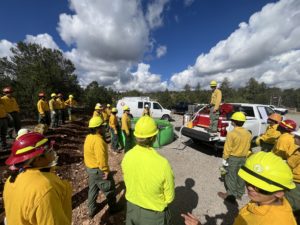
FSYC crews receive hands-on training on the use of engines to pump water to fires
On a warm morning in late August, fifteen strangers gathered in Albuquerque, New Mexico for their first glimpse of what would become a life-changing chapter in their careers. As new crew members in the Guild’s Forest Stewards Youth Corps (FSYC) program, these individuals had expressed an interest in working in natural resources in their home communities; few had any prior experience in this field but a willingness to learn and a determination to stick with it would prove key. Over the course of the next three days, the bigger picture of what this seasonal job would demand became clear as each crew became a tight-knit cadre. Though no promises of physical comfort or consistent scheduling were made, the three crews from Mountainair, Santa Fe, and Pueblo of Jemez were eager to get their hands dirty.
The first full week of training encompassed all the coursework and fieldwork necessary to become a wildland firefighter. Crew members studied the factors of fire behavior, weather effects, and topography before heading outside to complete hands-on training. Physically constructing a hose assembly from a fire engine was a tangible bridge from the theoretical classroom work already completed. Other important lessons included hand line construction (and the realization of how tiring it is!), radio communications, and backcountry navigation. The social-emotional aspect of this week of training was also a vital learning experience; crews camped out together, shared meals, and spent free time playing basketball in a gravel lot. In an age of increasing social deprivation, simply connecting with one another without technological distractions was a huge success.
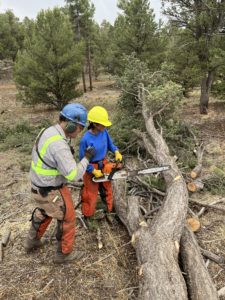
Hope Rosetta-Suina of the Espanola FSYC crew receives guidance on bucking and limbing a downed tree.
After a long Labor Day weekend full of rest, relaxation, and hot showers, the crews gathered back together for the last week of their formal onboarding: wildland fire chainsaw training. While many rural New Mexicans have some level of experience operating chainsaws to gather firewood, there’s a big difference between running a saw on private land for personal projects and operating one on a fire line to complete operational objectives. In a way, the crew members with no prior saw experience had an easier time as there was no pre-existing muscle memory or poor technique to overcome. Chainsaws are a powerful tool on the fireline, capable of downing hazardous trees, clearing brush, and bucking up burning logs into manageable lengths. With that utility, however, comes an inherent amount of risk; a misguided tree falling can easily damage personnel or vehicles, and an ounce of carelessness by the saw operator can result in an emergency evacuation. To combat this, heavy emphasis in training is placed on proper saw control, situational awareness, and backcountry medical care in the event of an incident. Crews practiced evacuating a victim from the forest on a team-carry litter and the complex logistics that exercise entails. By the end of the week, each crew member had demonstrated aptitude by assessing a tree’s hazards, creating a falling plan, and executing that plan to a safe completion.
Upon finishing these two weeks of immersive training, our three crews returned to their host units to begin the crucial on-the-ground work they were brought on to complete including fire line preparation, forest thinning, and prescribed burn implementation. But before the first shovel even hit the ground, the FSYC program had already become a resounding success. Empowering and enabling young New Mexicans to contribute to their
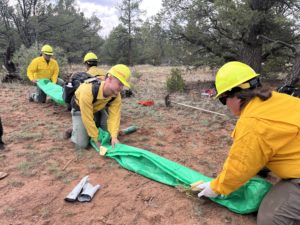
Clay Brewer and Atalaya Stanley of the Mountainair FSYC crew practice repacking a fire shelter.
local economies and ecologies has always been a stated goal of FSYC, but to watch a cohort of inexperienced individuals transform into a confident, proficient, and cohesive professional unit capable of anything they put their minds to, now and in the future, is the real beauty of the program. Whether these crew members continue on to careers in wildland fire, forest management, or something completely unrelated one thing remains true: FSYC continues to serve as a powerful tool for professional development, personal growth, and investment in the next generation of rural New Mexican communities.