
Capstone Match Season for MENV
Written by Daisy Ranney Smith
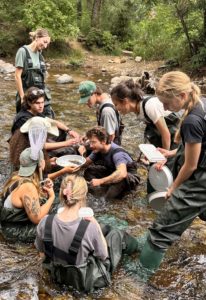
Daisy (right) and some MENV peers
Tuesday, December 16th is an exciting day for master’s students at the University of Colorado Boulder, more specifically those in the Masters of the Environment (MENV) program. It is capstone/thesis match day. Each year MENV offers students the opportunity to solve real-world sustainability and climate problems with partner organizations. Over the next twelve months, students will design and implement impactful projects in response to partners’ carefully curated proposals and under their mentorship and guidance.
As a first-year MENV student specializing in Environmental and Natural Resource Policy, I have been partnered with Aspen Global Change Institute (AGCI). Aspen Global Change Institute is a small nonprofit located in Basalt, Colorado, working to advance global change science and solutions. Their work takes place on a local, regional, and global scale and has helped make sense of change across Earth’s physical, natural, and human systems. Over the next twelve months I will work in a team of three students to assist AGCI in supporting decision-makers and resource managers to adapt to climate change with an emphasis on climate science that is politically resilient and decision-relevant.
The Intermountain West region is experiencing pronounced climate impacts including warmer temperatures, intensified drought, and earlier snowmelt all of which increase the size, severity, and frequency of wildfires. Wildfire and water are especially interconnected, with impacts on water systems, some of which include: changes in how quickly water moves through the system resulting in both more and less amounts of water in streams at different points throughout the year, compromised drinking water quality, reduced snowmelt infiltration with changes in soils and canopy cover, and increased sediment and debris flow.
Our work as students will be to understand and focus on the science and management needs between water and wildfire in a swiftly changing climate. This kind of work might include studying extreme weather events (droughts, floods, heat waves, snowpack) as well as the different approaches that water managers have for climate adaptation, such as case studies and leading practices. As a team, we will conduct thorough research and engage regularly with stakeholders. We will produce a written report or review that highlights the science synthesis of key concerns for the wildfire-water interface and/or the changing nature of climate extremes. My team will also create content for the Colorado River Science wiki pages to connect with a broader audience about the state of science in the Colorado River basin. Lastly, we will be presenting our research and work to different audiences over the course of the project with a final symposium day at the end of October 2026.
Climate resilience in the Intermountain West is an ongoing effort that requires a deep understanding of post-fire risks. These risks demand innovative and collaborative solutions that are driven by strong science and will influence important policy. As a young professional who is passionate about climate change mitigation tactics and the overlap of science and policy, I am excited about this opportunity to apply my skills and produce meaningful work that informs decision-making tools and guides scientists. I look forward to collaborating with my peers in a professional setting, serving stakeholders and learning from experts in this field. I am confident that this work will be challenging but highly rewarding, forcing me to obtain new skills and key knowledge that will guide me forward on my career path. I can’t wait to get started!