
Birds, Bogs, and Forestry – a two-day Lowland Spruce Workshop in Minnesota
Written by Christian Nelson, Forest Stewards Guild Lake States Coordinator
Fifty foresters and wildlife managers gathered in early October at the University of Minnesota’s Cloquet Forestry Center for a rich discussion on black spruce biology, ecology, economics, and management and capped the event with a field tour of the renowned Sax-Zim Bog. This extensive bog is one of the only places in the Lower 48 where boreal bird species can be consistently seen. The site attracts birders from across the nation, including a visit from Owen Wilson’s character in the 2011 film The Big Year starring Wison alongside Steve Martin and Jack Black. 
The two-day event was organized by American Bird Conservancy Northern Forests Conservation Delivery Network Coordinator, and Guild member, Jayme Strange, in partnership with several organizations including the Forest Stewards Guild and the University of Minnesota. The event tied in aspects of the recently completed Forestry for Minnesota Birds Guidebook.
Black spruce (Picea mariana) is a long-lived, boreal tree species found in areas with cold and short growing seasons. This species is at the southern extent of its range in the Great Lakes and Northeastern parts of the U.S. but is found widely across the Canadian and Alaskan boreal forest before diminishing as the boreal forest meets the tundra in the far-north.
In Minnesota, black spruce is primarily found in low, peatland and muck soil bogs and fens that range in size from small depressions to massive bog complexes. Black spruce is also found as an upland species in the far northeastern part of the state on shallow soils over bedrock. Overall, black spruce is considered the dominant cover on roughly nine percent or 1.4 million acres of the state’s forested lands. Many of the peatland stands are nearly pure black spruce. In other areas, it grows in association with other species. On wet sites it is found in association with tamarack and northern white cedar, and on dryer sites it is found with aspen, paper birch, jack pine, red maple, white spruce, and black ash.
Black spruce is an important economic resource in Minnesota, coming in (a distant) second place behind quaking aspen in pulpwood utilization. Black spruce produces long, strong, wood fibers that are required for producing high quality paper products. It is also utilized by sawmills when it is available in large enough diameters. As dimensional lumber it is known for straight lines, durability, light weight, and dimensional stability. The tops of small black spruce trees, especially those found in wet, near-stagnant stands, are sold across the U.S. for ornamental winter season displays, like mini-Christmas trees.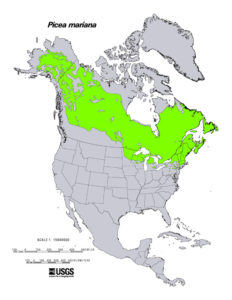
Black spruce stands also provide essential habitat for several wildlife species including the Connecticut Warbler, Golden- and Ruby-crowned Kinglet, Boreal Chickadee, Dark-eyed Junco, Spruce Grouse, Great Gray Owl, bog lemming, and snowshoe hare. The understory of black spruce stands often consists of a soft carpet of sphagnum mosses and wetland plant and shrub species like leatherleaf, cottongrass, pink, yellow, and Showy Lady Slippers (Minnesota’s state flower). Dense stands can provide cool summer habitat and warmer winter habitat with lower snow depth than adjacent areas.
Historically, black spruce has been managed using even-aged silviculture techniques such as clear cutting and strip-cutting. Post-harvest areas are often replanted with nursery stock or aerial-seeded using planes or helicopters. Dwarf mistletoe, a native-parasitic plant that causes short-stubby growth, slow decline, and eventual mortality, has long been cited as a reason to harvest all trees over five feet tall within a stand with no reserves.
A cultural shift in forestry practices and concern for declining wildlife dependent on spruce stands, has many foresters looking for silvicultural alternatives that more closely resemble historic disturbance patterns and the resulting heterogeneity in stand structure, age, and species composition that may result. Climate issues also fuel concern for the long-term prospects of a species growing at the southern edge of its range across the U.S.
Throughout the two-day workshop, experts made a case that concerns about dwarf mistletoe may be overstated. Pockets of mistletoe-caused mortality are often found to harbor other tree species, adding to species diversity, climate change resilience, and providing more habitat than black spruce alone. Structural diversity can be enhanced by strip cutting, or group-selection, providing continuous habitat not seen in traditionally managed clearcut areas, while reducing reforestation costs. Stand features, such 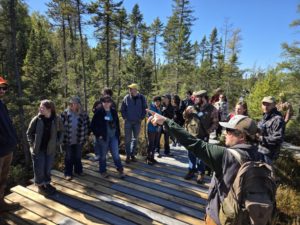 as species diversity, vertical and horizontal structure, age diversity, standing dead trees, downed wood, gaps, and retained groups of living legacy trees, greatly increase the value of the stand to wildlife without degrading the short-term economic viability of management nor long-term economic value of the stand. Foresters and wildlife managers at the meeting discussed experimentation and thinking about outside-of-the-box approaches to achieve economic goals while retaining and enhancing wildlife value.
This event challenged attendees to weigh the complex tradeoffs inherent in forest management. It was particularly interesting to think about these tradeoffs in a plant community that is often overlooked and understudied yet provides critical ecological and economic benefits to the region. We did not end with a clear answer on how to proceed. That answer likely falls firmly in the land of ‘it depends’ but the discussion was rich, enlightening, and inspiring.
The morning and afternoon first-day presentations were recorded and can be watched in their entirety on the Northern Forest Birds Network YouTube channel: https://www.youtube.com/@northernforestbirdsnetwork