
Beauty in the Bog: A Natural History of Eastern Larch
Written by Jonathan Grabowski
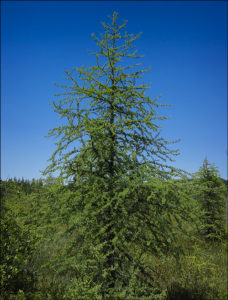
Eastern larches thrive out in the open. When exposed to full sun, as shown here, the larch will take on a pyramid-like shape. If the tree becomes crowded by competition, it will self-prune dramatically and become narrow. Photo credit Paul Smith’s VIC
From early June to late August, I worked on the Refuge Stewardship Partnership project with the Guild as a Forest Monitoring Technician. Most of my time was spent trudging through the bogs at the Nulhegan Basin of the Silvio O. Conte National Wildlife Refuge, installing 56 long-term forest monitoring plots. During my first day in the field, my tree identification skills were tested when the Refuge’s forester, Jeremy Goetz, asked me to identify an unusual-looking conifer.
I had just learned that red spruce has sharp needles and balsam fir has flat, “friendly to touch” needles, but this tree was different since the needles were short and felt spongy. This tree seemed familiar; however, I couldn’t think of where I’d seen it before. Then I remembered that I used to take care of a tree just like this!
I recalled spending ages watering this thirsty tree back when I was a student at Washington & Jefferson College, working as the Arboretum Technician. That’s when the name came to me: “This is an eastern larch, right?”
The eastern larch (Larix laricina), also known as tamarack, American larch, and hackmatack, is an extraordinary tree. Just like all the other trees in the Larix genus it is a conifer yet displays a characteristically deciduous trait. Its needles will change from a blueish green to a beautiful gold before the tree sheds them altogether in the fall.1-5
Eastern larch can be found in New England, the Great Lakes region, extending west to Minnesota, and is also present in Alaska and Canada. There are other native larches in North America, like western larch (Larix occidentalis) and subalpine larch (Larix lyallii), which can be found in the Pacific Northwest.
To identify an eastern larch, observe its unique needle arrangement and bark. The 1-inch-long needles stem from spur shoots along the branches in clusters of 20 to 50 and lack the waxy cuticle that is typically found on conifers. This is an evolutionary benefit for the eastern larch because it allows the tree to expend less energy on needle production. The bark is usually a reddish gray and may look flaky or scaly.
This tree species can grow to be 40 to 80 feet tall, comparable to a 4 to 8 story building, and is commonly found in wet, peaty soils like swamps and bogs. As a seedling, an eastern larch can be transplanted outside of wet areas since it can tolerate drier soils.1,3,4 It may also be found in old cemeteries because eastern larches were planted to represent death and rebirth prior to the Civil War Era.

A closer look at a branch of an eastern larch shows its clusters of short, spongy needles. This photo, taken by RSP monitoring technician Jonathan Grabowski, shows how the new growth looks yellow-green, but the needles develop a blue tinge as they mature.
At just fifteen years old, eastern larch trees can start producing cones. When young, these cones are about the size of a penny. As the season progresses and the seeds inside mature, the scales open and the cones flare out to about the size of a quarter. Larches appear top-heavy during good seed years and can be crowded with up to 20,000 cones. Seeds disperse from September to October, primarily by wind and to a lesser extent by red squirrels.
Of all the seeds that land on the ground, only about 4 to 5 percent will actually germinate and stand a chance of growing into new trees. Seeds that don’t germinate within a year are unlikely to ever grow—unlike some seeds that can stay dormant longer, these won’t survive long in the seed bank and are commonly preyed upon by mice and voles. With the right conditions—a moist but not waterlogged substrate like sphagnum moss and plenty of sunlight—eastern larch seedlings can grow surprisingly fast, reaching 7 to 9 inches in their first year.
Throughout history, the wood of the eastern larch has had many different uses because it is tough and highly rot resistant. The Algonquin, an Indigenous group from Canada and parts of New England, used the eastern larch’s inner bark for medicinal purposes. Cordage was made from the tree’s root string and used to sew birch bark canoes together. The common name ‘hackmatack’ comes from the Algonquin word for snowshoe, indicating the tree’s value in northern climes.
During the colonial era, white settlers used eastern larch wood as “knees” to join the deck timbers of ships and collected its squooshy needles to stuff pillows. Today, eastern larch is used for planking, railroad ties, fence posts, telephone poles, and in shipbuilding.

Jonathan Grabowski graduated from Washington Jefferson College with a degree in Environmental Science (class of ‘24). As a Forest Monitoring Technician with the Guild (summer of ‘25), he gained a deep appreciation for the larch trees and spongy sphagnum moss of Nulhegan, although the persistent deer flies left much to be desired.