
ForestHer NC: Making Forestry Stronger, Together
Written by Mackenzie Alexander and Kelly Oten
Women’s Work in History
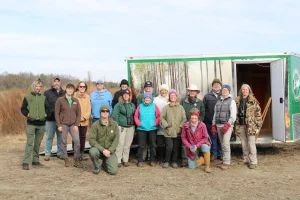 Women have always been a part of forestry. Historically, women often helped guide family decisions about when to cut, which trees to save, and how best to steward their land for the next generation. Historical accounts from the Southern Appalachians describe women’s roles in decisions about timber harvesting and prioritizing long-term forest health. These often-uncredited contributions are even reflected in Aldo Leopold’s A Sand County Almanac (1949), in which describes his stewardship philosophy informed not only by his professional experience, but by shared responsibility, where the perspectives of his wife and daughters played an important role.
One of the earliest women conservationists to receive widespread recognition was Rachel Carson, whose book Silent Spring published in (1962), profoundly influenced how we think about long-term ecological impacts and land stewardship. While many of these contributions were informal or went unrecognized at the time, they nonetheless influenced how forests were managed and valued. That influence didn’t disappear; it just wasn’t always visible.
Founding ForestHer NC
Today, many women continue to bring these same stewardship values to their land and work but maywithout not always havinge access to the same networks or learning opportunities that have historically shaped how forestry knowledge is shared and applied. Many women describe learning forestry by figuring things out as they go, often without a clear place to ask questions. Recognizing the importance of accessible education, peer connection, and supportive learning spaces can help shape efforts to better engage women in forestry in ways that build on, rather than replace, existing practices. And that belief is what led to the creation of ForestHer NC.
ForestHer NC (FHNC) was founded in January 2019 by a group of natural resources professionals and private forest landowners who recognized a common challenge: many women landowners needed better access to information, support networks, and welcoming educational spaces to manage their forests confidently.
ForestHer Mission
Our mission centers on equipping participants with knowledge, skills, and community connections so they can confidently manage forestland and make informed decisions about their land. Programming spans all major regions of the state,— from the Coastal Plains to the Piedmont and Blue Ridge Mountains, —and is designed to be inclusive and accessible, intentionally centering the experiences of women who have historically been underrepresented in forestry and natural resources fields.
That mission comes to life through a range of educational opportunities. Since its inception, FHNC has grown into a network that offers educational workshops, field days, webinars, and community events that span a wide range of forest-related topics. These events often bring together experts in forestry, wildlife management, prescribed burning, bird and wildlife identification, and other forestry topics to provide hands-on learning opportunities and practical skills. Many women note that traditional field
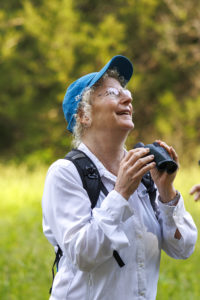
Caroline Ray smiles while searching for birds during a Piedmont songbird identification workshop hosted by ForestHer at Eno River State Park in Durham Friday, May 3, 2024.
days can be intimidating or unfamiliar. Providing targeted workshops in a supportive peer environment helps address these barriers and encourages greater participation in forest management activities.
Meeting a Need
A core purpose of FHNC’s programming is to respond to real needs identified by women landowners and professionals. As ForestHer NC grew, we wanted to better understand whether our programming was truly meeting these needs. In 2023, we partnered with Duke University Master of Forestry student Emma Childs to evaluate participant experiences. A total of 126 participants representing a range of ownership statuses and regions across North Carolina contributed to the evaluation.
Results from the evaluation showed strong interest in wildlife habitat management, invasive species management, prescribed fire, and continued learning, all of which are areas that align with FHNC’s experiential programming. Past events have included workshops on forest management, wildlife habitat management, the cultural significance of longleaf pine ecosystems, prescribed burn demonstrations, and interdisciplinary field gatherings that combine ecological education with opportunities for networking and shared experience.
Learning in Community
Across these events, we consistently see the same thing: learning feels more accessible (and more enjoyable!) when it happens side by side with others navigating similar questions. Because we develop our programs in collaboration with conservation agencies and organizations, we can balance technical depth with community building. The focus is on learning by doing, paired with time to connect with others facing similar challenges. That approach has been well received. Participants frequently share that these events are the first time they have felt comfortable asking questions, handling equipment, or discussing management decisions without judgment.
These themes were apparent in Childs’ participant experiences. Prescribed fire emerged as a practice that participants viewed as both ecologically valuable and logistically intimidating. Women landowners, especially those managing smaller or urban-adjacent tracts, described significant uncertainty around how to begin, who to contact, and whether their land would be prioritized by agencies with limited capacity. These insights help clarify why hands-on burn demonstrations (Learn and Burns) and community-anchored opportunities like Prescribed Burn Associations have become an important part of FHNC programming.
FHNC maintains a strong commitment to diversity, equity, and inclusion. The organization actively works to create programming and community spaces that are welcoming to women and attentive to the ways race, socioeconomic status, land tenure history, and ability impact access to forestry education. This emphasis supports equitable access to education and stewardship opportunities across diverse landowner and professional communities.
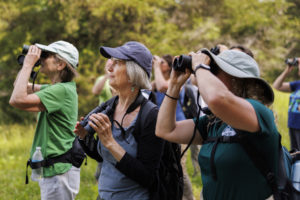
Attendees look through binoculars searching for birds during a Piedmont songbird identification workshop hosted by ForestHer at Eno River State Park in Durham Friday, May 3, 2024.
In 2025, FHNC hosted six different events across North Carolina, made possible through partnerships and sponsorship form organizations like: The Nature Conservancy, North Carolina Forest Service, North Carolina Tree Farm Program, North Carolina State University– – Extension Forestry, North Carolina Wildlife Resources Commission, Black Family Land Trust, Forest Stewards Guild, and other local partners across the state. These collaborations, along with strong relationships with engaged landowners, is what makes it possible to offer programming across North Carolina’s diverse landscapes, from the Coastal Plains to the mountains, while connecting participants to resources and people they can turn to long after an event ends.
Planning for the Future
Looking ahead to 2026, FHNC will continue to evaluate success not only by the number of events, but also by its ability to operate sustainably, transition leadership smoothly, and reduce reliance on external support. With strengthened governance, clear operational procedures, and robust programming, FHNC is well-positioned to continue growing its impact, building capacity among participants, and fostering a more inclusive and skilled forestry workforce across the state.
Women are playing an increasingly visible role in shaping the future of forestry as landowners, practitioners, researchers, and leaders. As forests face novels challenges, from invasive species to land-use changes, it matters more than ever that people feel equipped and supported in caring for them. Creating spaces where women can learn together and build confidence isn’t about changing forestry; it’s about making it stronger.
Mackenzie Alexander is the 2026 Chair of ForestHer NC and Southeast coordinator of the Forest Stewards Guild. Kelly Oten is the 2025 Chair of ForestHer NC and assistant professor and extension specialist of forest health at North Carolina State University. ForestHer NC is building confidence, connection, and stewardship among women landowners and forestry professionals across North Carolina. To learn more, visit https://www.foresthernc.org/.