
Ten Years of Adaptive Silviculture for Climate Change
Written by Maria Vicini and the ASCC team
Climate change will impact different forest ecosystems in varying ways, and management strategies to adapt forests to these risks varies across ecosystem conditions, management goals, and desired future conditions specific to the target location. The Adaptive Silviculture for Climate Change (ASCC) Network was established in 2009 in response to this need for localized, operational examples of climate adaptation in different ecosystem contexts. The Network is a collaborative effort to establish a series of experimental silvicultural trials across different forest ecosystems, aiming to provide managers with examples of how to integrate climate adaptation into their silvicultural planning and management actions.
Since the project began, the Network has grown to become the largest experimental silvicultural program in North America, spanning 14 research sites and over 200 management and science collaborators. This partnership reach is continuously growing across universities, state and federal agencies, conservation organizations, non-profits, student researchers, extension programs, and other groups in the adaptation space. Current research sites are located across the US and Canada, spanning a variety of forest ecosystems, as shown in the following map.
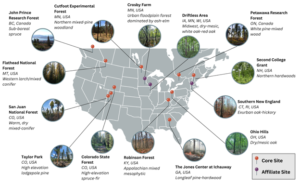
A map of the 14 ASCC sites. Graphic created by Maria Vicini. Figure adapted from Nagel et al. (2025).
A key aspect of the network is its robust experimental design. Each network site tests three adaptation strategies, designing treatments to align with these adaptation concepts: Resistance, Resilience, and Transition, as well as a no-action control treatment. This creates a consistent framework to test outcomes across sites and determine how desired outcomes are achieved across a range of potential acceptable outcomes.
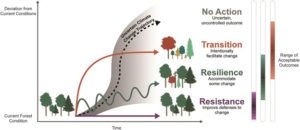
Conceptual diagram of the resistance-resilience-transition framework applied to the ASCC Network. Graphic created by Kailey Marcinkowski. Figure adapted from Nagel et al. (2025).
In 2017, the Network published a conceptual paper in the Journal of Forestry outlining the ASCC experimental design and the impetus for this work, titled: Adaptive Silviculture for Climate Change: A National Experiment in Manager-Scientist Partnerships to Apply an Adaptation Framework. Read the Nagel et al. (2017) paper here.
Since then, the Network has grown in both capacity and impact, ranging from the publication of peer-reviewed manuscripts to fostering climate adaptation work across various disciplines. Since the Network’s inception, collaborators have published at least 26 peer-reviewed manuscripts, informing the fields of forestry and ecology, along with rangeland management and other biological disciplines. For example, this magazine featured an article in 2023 on Assisting Tree Migration To Adapt to Climate by Guild members engaged in the Network. The Resistance-Resilience-Transition framework and coproduction process between managers and scientists at each ASCC site has served as a model for practitioners working in the climate adaptation space. ASCC sites have also been incorporated into training modules and workshops for foresters and other managers, including the National Advanced Silviculture Program, and has trained thousands of forestry professionals.
These impacts, along with a background on the ASCC Network and experimental design, are highlighted in the newly published conceptual paper on the Network and its role in the climate adaptation space. This paper is titled, Ten Years of Adaptive Silviculture for Climate Change: An Applied, Coproduced Experimental Framework. Read the Nagel et al. (2025) paper here.
The ASCC Network website contains additional information about the overall effort, as well as more detailed descriptions of the forest management prescriptions for each site. You can also listen to a podcast episode covering the new paper from the ASCC podcast series, ASCC’ing the Experts, which features an interview with Dr. Nagel.
An upcoming webinar hosted by the Forest Steward Guild on Thursday, March 5 at 12 PM MT/2 PM ET will dive into these key topics covered in the manuscript, including:
- An overview of the ASCC experimental framework
- How silviculture is central to the implementing climate adaptation
- Definitions, advances in applying the Resistance-Resilience-Transition adaptation pathways and expected outcomes of the ASCC framework.
- Emergent trends across the ASCC Network and key lessons learned
- Core principles of the ASCC Network and its contribution to the broader adaptation community
You can RSVP for the webinar via the Forest Stewards Guild event registration page for the event.